
Riga Autumn Legends rogaining
Regulations Programme How to get there & competition centre Map
LEGEND OF ĶENGARAGS AND ITS SURROUNDINGS
Ķengarags, once known along the Daugava bend for its fishing hamlets and river-mist-hidden roadside paths, has for decades preserved stories about old mill ditches, boat piers and vanished manors, in whose place now rise multi-storey housing blocks. Legend has it that in the late hours of the night, when the river is calm as glass, you can still hear the hum of old ships and the voices of merchants who seem unwilling to abandon their ancient routes. In this maze along the Daugava riverbank, the rogaining also gains a special character — a game between present and past, where participants run along the same paths once walked by fishermen, workers and city border guards, searching for control points in places where legends still whisper beneath their footsteps.
competition schedule and programme
 Add the event to Google Calendar, or
  Add the event to Apple Calendar
| Time | Activity |
|---|---|
| 09:30 | Race number and map distribution starts |
| 11:00 | Start of the 6h rogaining (Rogaining hike participants may start between 11:00 and 13:00) |
| 11:30 | Start of the 3h MTB rogaining |
| 12:00 | Start of the 4h rogaining |
| 13:00 | Start of the 2h rogaining, 2h Solo rogaining and 2h rogaining hike |
| 14:30 | Finish time limit for the 3h MTB rogaining |
| 15:00 | Finish time limit for the 2h rogaining and the 2h rogaining run |
| 16:00 | Finish time limit for the 4h rogaining |
| 17:00 | Finish time limit for the 6h rogaining and the Rogaining hike |
| 17:10 | Awards ceremony for all courses and INTERVALS.LV lottery with Garmin and other prizes |
Competition centre location and terrain
The competition centre will be located near the Akropole Riga shopping center.
LEGENDS HIKE
The Hike of Legends is an interactive adventure that transforms an ordinary walk into an exciting journey of discovery. It is designed for every participant to explore local secrets at their own pace, without the rush of competition. Using the Actionbound app, your smartphone becomes your personal guide—as soon as you reach a task location, legend stories and game questions will automatically open on your phone. In nature, these locations are easily spotted by orange and white fabric markers (prisms). The app tracks your location automatically, so you can focus entirely on exploring your surroundings.
Distances formāti:
- 10 km Family Route (2–3 h): Follow the marked line on your phone—stories and game elements for both children and adults.
- 20 km Adventure Distance (4–5 h): Follow the route on your phone—a physical challenge with interactive tasks.
- Hike with a Map: Plan your own route and find checkpoints in any order, using the app only to complete the tasks.
How to Prepare?
- Install the Actionbound app (available on the App Store and Google Play) .
- Receive your map and a unique QR code for distance activation at registration.
- Start your hike at a time convenient for you (see the "Start Window" in the Program section).
Medals and Prize Draw
Just like participants in other distances, hikers will receive commemorative medals and goodies from our supporters at the finish line, as well as entry into the lottery.
Bonus: Participants who answer at least 5 questions correctly in the app will be entered into a special draw for additional prizes at the start of the lottery.
The distance can be completed at any time. However, to receive a medal and participate in the lottery, you must finish no earlier than the start of the final distance and no later than 30 minutes after the control time of the final distance.
FIND A TEAMMATE!
Rogaining is a strategic team orienteering event where planning and a shared adventure are an essential part of success. So that no one has to stay home just because they are missing a partner, this season we have created a special platform for finding teammates.
How does it work? Join our official Facebook group, write a post about your planned distance and pace, and head out on the course with new teammates!
Find teammates here: facebook.com/groups/rogainings
Map symbols
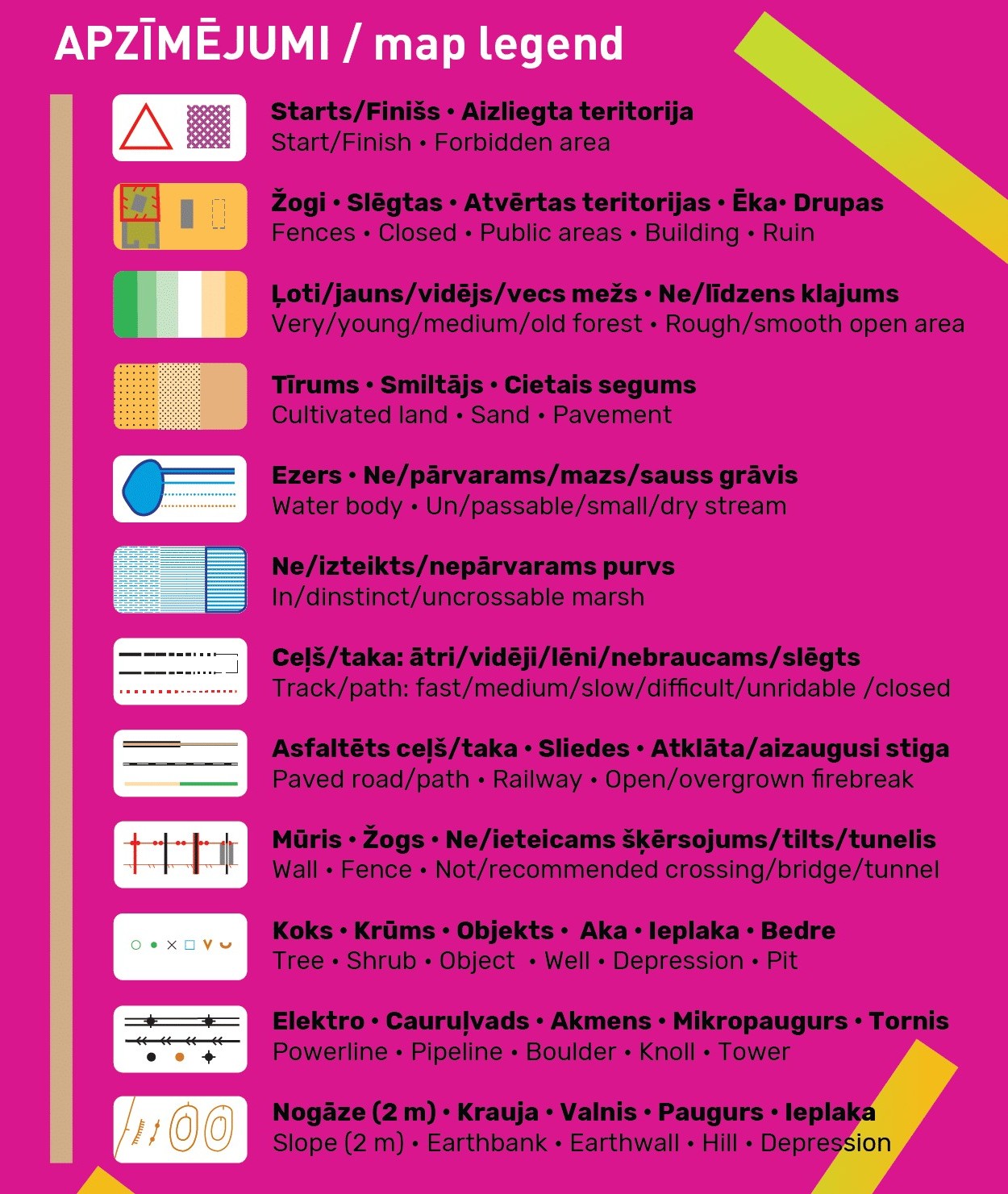 Since this year all stages can also be done by bike in the MTB class, for the convenience of cyclists the map distinguishes asphalt roads (brown) and unpaved fast/medium/slow/very slow roads and paths (the more “wiggly” the symbol, the slower). Narrow rides/tracks drawn with the narrow ride symbol represent tractor tracks that are unsuitable for cyclists, but runners may try to squeeze through.
Vegetation is shown as close as possible to the gradual transitions observed in nature from very young to young, to middle-aged and old stands, using four different colours: green, lighter, very light and white — as orienteers are used to in their maps. But unlike classic orienteering maps, these colours do not indicate runnability, only the age of the forest. This more detailed forest representation is possible thanks to the laser point cloud data published by the Latvian Geospatial Information Agency, which anyone can download for free and use to generate map layers.
Please note that areas coloured olive green according to standard orienteering symbols are out of bounds for participants. Closed roads are coloured red. Even if something is not marked on the map, but you see a sign in the terrain saying “Privātīpašums” (Private property) or “Ieeja aizliegta” (No entry) (unless it is clearly very old and no longer valid), please respect it and choose another route. Of course, first and foremost the organisers will try to plan control points so that access to them does not infringe landowners’ rights.
Contour intervals will be a relatively detailed 2 m.
COMPETITION MAP AND TERRAIN
Participants will receive the competition maps on race morning when registering at the registration tent. The maps will be laminated for moisture resistance; however, moisture may still enter at the edges, corners and damaged spots. Long-course participants, the most enthusiastic swimmers and marsh crossers can tape the map edges with transparent tape for extra durability or even place the maps in special transparent, waterproof map holders. The map scale is 1:20 000, i.e. 1 cm on the map = 200 m in the terrain. Size 62 x 43 cm (take this into account when choosing a bike map holder).
Most of the area is covered by well runnable pine forests, with sandy dunes in places. As a result, almost all roads crossing dunes turn into sandy tracks that are unrideable for cyclists (although there may be parallel micro-paths ridden in). On the map, many such unrideable sections are shown with the narrowest ride symbol (and not the thick road/path symbol), but, as with all general rogaining maps, some imperfections are possible. In the lowest relief areas there are wide, marshy flats with shrubby, hard-to-cross vegetation. However, after prolonged dry periods, the marshes can be fairly dry. Water levels in ditches are also often lower than usual.
Control point descriptions
Familiarise yourself with the control point descriptions! Although you always have to look for the feature located in the centre of the circle, the descriptions explain more precisely whether to look on the north or south side of a building, etc. Some of the control point locations are so legendary that we had to encode them so as not to give away the answers too early. Still, you can try to decipher them even now. You’ll find out the correct answers on race day before the start, when you receive the map with control points.